

Focus Fusion

Focus Fusion—safe, unlimited, economical energy

alt

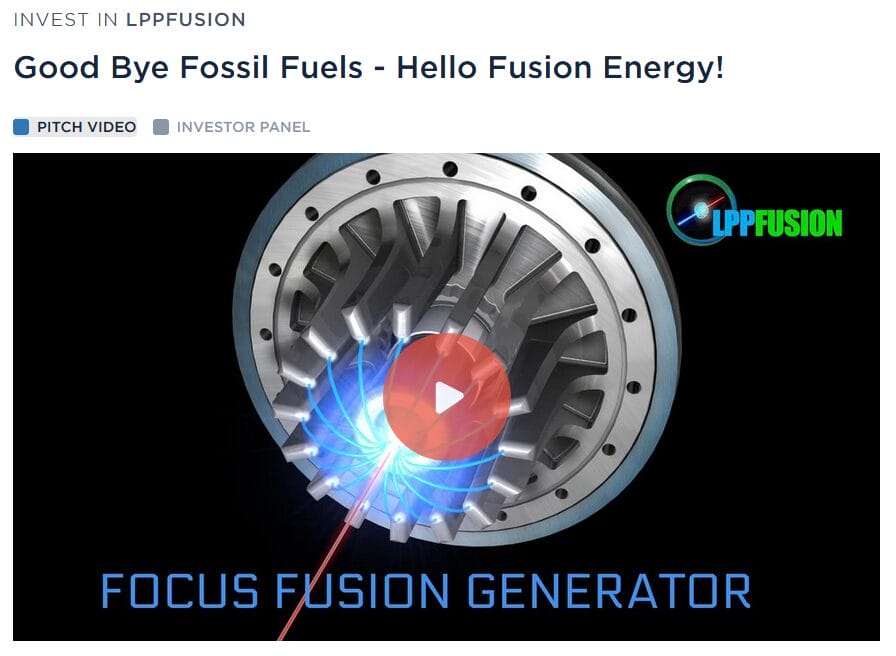
LPP is developing a revolutionary new source of energy called "Focus Fusion", based on the dense plasma focus device and using hydrogen-boron fuel.

Focus Fusion reactors could provide virtually unlimited supplies of cheap energy in an environmentally-sound way. They would produce no radioactive by-products or pollutants. The end-product would be harmless helium gas. Focus Fusion reactors would be free of long-term radioactivity, and the small number of low-energy neutrons emitted could be easily absorbed in several inches of shielding.

Focus Fusion reactors would be cheap to build and operate. Almost all of the energy would be released through the motion of charged particles that could be converted directly to electricity, eliminating the need for generating steam to drive turbines, which accounts for most of the cost of electricity today. Focus Fusion costs may be as much as one hundred times less than present energy costs.

Focus Fusion reactors would be small and decentralized. They could fit into a garage-sized area and be made as small as 5 MW, sufficient for a small community.

Focus Fusion energy is essentially unlimited. The raw materials for hydrogen-boron fuel are exceedingly common. Hydrogen comes from ordinary water and boron from either abundant deposits or from sea-salt. Supplies of boron would be sufficient to maintain overall power consumption ten times the present global level for a billion years.

alt

LPP has taken major steps towards proving these reactors feasible.

-- In August 2001, a small team of physicists led by Lerner demonstrated for the first time the achievement of temperatures above one billion degrees in a plasma focus device, high enough for hydrogen-boron reactions.  This breakthrough, reported at an international scientific conference in May 2002, took place at Texas A&M University and was funded by JPL.

-- In March 2003, Lerner presented new theoretical analysis at the prestigious 5th Symposium on Current Trends in International Fusion Research in Washington DC, showing that the magnetic field effect could greatly reduce the cooling of hydrogen-boron plasma by X-ray emission, and make the production of net energy far easier.  The presentation was favorably received by some of the top fusion experts in the world.

-- In February 2004, Lawrenceville Plasma Physics completed a preliminary simulation of plasmoids that burned proton-boron (pB11) fuel.  The simulation results confirmed that net energy production is possible with a small Focus Fusion device.

-- In February 2006, Lawrenceville Plasma Physics submitted a patent application to the US Patent Office.  The patent application, entitled "Method and Apparatus for Producing X-rays, Ion Beams and Nuclear Fusion Energy", covers the use of high magnetic fields (the magnetic field effect) in the production of fusion energy, the injection of angular momentum into the plasma sheath, and a new method of converting X-ray energy into electricity.

alt

-- In December 2007, LPP began to develop a sophisticated computer simulation aimed at understanding the formation of the plasmoids in the dense plasma focus reactor in detail. This work is being carried out in collaboration with Dr. John Guillory, Professor Emeritus at George Mason University, and Dr. David Rose of Voss Scientific, Inc. 

-- In December 2008, LPP initiated its planned two-year experiment after receiving $1.2 million from private investors and The Abell Foundation.  Two plasma physicists will be joining Eric Lerner on the experimental team, Dr. XinPei Lu and Dr. Krupakar Murali Subramanian. Dr. Subramanian was Senior Research Scientist, AtmoPla Dept., and BTU International Inc., in N. Billerica, Massachusetts. He worked for five years on the advanced-fuel Inertial Electrostatic Confinement device at the University of Wisconsin, Madison, where he received his PhD in 2004 and where he invented new plasma diagnostic instruments.  To help in the design of the capacitor bank, LPP hired a leading expert in DPF design and experiment, Dr. John Thompson.  Dr. Thompson has worked for over twenty years with Maxwell Laboratories and Alameda Applied Sciences Corporation to develop pulsed power devices, including DPFs and diamond switches.

-- In January 2009, the US Patent office issued Patent 7,482,607, Method and apparatus for producing X-rays, ion beams and nuclear fusion energy, to Eric J. Lerner and Aaron Blake, with the assignment of the patent to Lawrenceville Plasma Physics, Inc.

-- In February 2009, LPP moved into its new office where the equipment was assembled.

-- Throughout 2009, Eric Lerner and the research team designed and assembled the DPF with initial tests conducted in October.  In September, Abdelmoula Haboub joined our scientific team as a Senior Research Scientist in September 2009. Mr. Haboub graduated from Cadi Ayyad, School of Science Semlalia, Marrakech, Morocco and holds Master of Science degrees in Physics, mechanical Engineering and Atmospheric Science. He is completing his dissertation for a PhD in physics from the University of Nevada. His experience in working with the z-pinch machine, which, like the DPF, produces dense plasma and his knowledge of the instrumentation needed for such dense plasma will be particularly valuable on our project.

Keep track of our current activities in our News section.

Watch a YouTube video of the Focus Fusion process in action


Quick Contacts

40 Ridge Drive
Berkeley Heights, NJ 07922

Phone: (732) 356-5900
Fax: (732) 377 0381

Click Here to Email

anti-SHRILL web design

I think that the “Focus Fusion” approach of Lawrenceville Plasma Physics, Inc. should be funded as the science behind it is very interesting. Even if this approach does not succeed in producing fusion energy, the research will produce valuable technology in the near term. - Bruno Coppi, Professor of Physics and Senior Fusion Researcher, MIT

The experimental program that LPP plans to carry out has great potential to show how the plasma focus can be used to generate fusion energy and to demonstrate the feasibility of hydrogen-boron fusion. In addition, the experiments will investigate the magnetic effect, which will be very exciting. Achieving giga-gauss magnetic fields with the plasma focus, getting gyro-radii of the order of the electron Compton wavelength, will certainly be new physics and will open up large new possibilities for energy production. - Dr. Julio Herrera, Professor of Physics, National Autonomous University of Mexico